The autobiography of a missionary
behind the Iron Curtain
What was it like to serve as a missionary behind the Iron Curtain, when communist governments restricted Christian ministry and access to the Bible? From Miracle to Miracle is the firsthand story of Ginger, an American missionary whose calling eventually took her into the communist world of Eastern Europe and beyond. Her journey began, however, far from the mission field—with a troubled marriage, a dramatic conversion to Christ, and a growing conviction that God was preparing her for something she could not yet foresee. Her story became one of faith, providence, danger, Bible smuggling,
and an extraordinary confidence in God’s guidance.
***
Foreword
By Roger and Dianne Smalling, Ginger’s son-in-law and daughter
Ginger was Dianne Smalling’s mother. Ginger was a missionary to the communist world before the Iron Curtain fell. This call led her around the world, both to Eastern Europe and Asia.
Gratitude to God for bringing her out of a desperate situation in early life to a ministry of adventure and miracles motivated Ginger to write her autobiography.
The events are not necessarily chronological because she had another intent than entertaining with adventures. She wanted to express the lessons God taught her through these events to prepare others for spiritual warfare in ministry where Satan has strongholds.
Ginger was not a theologian. She was an evangelist with a big heart for people and a gift of exhortation and encouragement. If the reader keeps the above in mind, Ginger will have succeeded in preparing you for spiritual warfare and how to win.
A travel partner, usually a person in training, always accompanied Ginger. She refrained from mentioning their names in the book for reasons of “security” during those tense years. We knew these people personally, and they authenticated for us the narrations in this book. Of some of the events, we were eyewitnesses.
Edited by Ginger’s daughter Dianne Smalling and her husband, Roger.
***
Chapter 9: Smuggling Bibles on Ships
Sweden, 1974
My favorite missionary chapter was Isaiah 54. It had a special meaning to me for I could not imagine how this chapter, written so many years ago, described my situation so perfectly.
That chapter says, the children of the desolate would be more numerous than those I had during my marriage. I began to see this become a reality by my experiences. I had two children and lost one by miscarriage. Yet now I had many more than two, in souls saved, just as precious.
The Lord advised me to enlarge my vision. I could visualize making my tent bigger, putting my roots in him, my stakes deeper and enlarging my vision, lengthening my cords.
It was so very applicable to me, for the Lord said I have called you as a woman forsaken. This described the very condition I was in when he called me. He goes on to say, I was abandoned by my husband but he, the Lord of Hosts, would be my husband.
These verses are the most personal and most cherished of all because they met my innermost need. I never felt lonely anymore, for the Lord was always there.
When people used to ask how it felt to be alone, so far from home, it always took me by surprise because I was not alone. I encourage anyone who feels deserted to share these promises with me. What he has promised me, he will do for you also.
The Lord also provided people to accompany me along the way. Sometimes he teamed me with others for a time. Then they would be gone. I am grateful for the alone times as God and I ministered together, just the two of us.
<><><>
When I thought of the Iron Curtain, I always pictured myself ministering in and out of Russia. But the Lord had different ideas.
I first had contact with Russians aboard Russian ships. While I was living aboard a youth hostel ship tied up at the dock at Stockholm, Sweden, the Lord woke me early one morning. I had the distinct impression I was to get dressed and catch a bus. I did so, not knowing exactly where God was leading me.
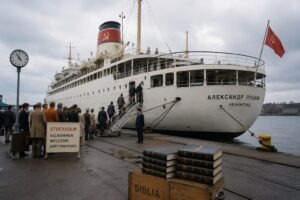 As I stepped up on the bus, I could see over the railing that separated the road from the water. Right next to us was a Russian ship. The hammer and sickle emblem was on the smokestack. It was a tourist ship. People were coming down the gangplank and boarding a bus at the bottom.
I knew then why the Lord had directed me out so early that morning. It was to see this ship. I knew I was supposed to take Bibles aboard, so I hurriedly gave an excuse to the bus driver, backed off, and walked briskly to a Bible distributor who printed Bibles for this purpose.
By the time I got the Bibles and returned, the people were getting off the bus and going back onto the ship. I surmised that they had gone shopping and sightseeing because many carried packages. I noticed I was about the same size and coloring as many of the women. So I mingled among the crowd and was almost shoved up the gangplank by them.
What I had failed to notice were two people waiting at the top. One was a lady who sat at a desk as she checked each passenger’s name and stateroom number as they came aboard. The other was an official-looking officer who gave the cabin key to each passenger. How could I possibly get past these two people? I did not even speak a word of Russian.
I could not have turned around and gone back if I had wanted, for the people were shoving, and there was no alternative but to proceed with the plan. I sent up a quick prayer that went something like this: “Oh Lord, it’s your problem; either you get me in or I can’t go. While I was praying, I must have accidentally passed both people. Was it an accident or an answer to prayer? I was on board.
People were walking around talking to one another, and I could hear the ship’s engines gently throbbing below my feet. What if the ship pulled out? No time for worry. I had a job to do. First I saw a library and went over to a bookshelf and took down a book, pretending to read it. I reached in my bag, took one of the Bibles, and put it in the place of the other book.
Next, the TV room. I went to a TV set and slid a Bible underneath the TV as I pretended to adjust the sound.
No one was noticing. My courage was building, so I began to walk down the corridors. Some of the doors to the rooms had signs in big brass letters I could not read. Perhaps they are the restrooms, I thought. I tried one of the doors, and sure enough, it was. I hid one of the Bibles in a place I thought it might be found later.
Soon, both bags of Bibles were empty. Mission accomplished. Now I needed to get off the ship. There was one small problem. The crowd with which I had come on board was not leaving, and no one was coming up the gangplank. The two officials were still there, filling out ledgers, so they would be a problem. I would certainly stick out like a sore thumb.
I prayed again, reminding the Lord I was depending upon him as I approached the gangplank. As I neared the two officials, I kept walking and simply passed by them. I was as surprised as anyone would be. I kept myself from hurrying, though every part of me wanted to run. And then my feet touched the dock once more. No one stopped me.
<><><>
I hurried to the shelter where two of my young colleagues were waiting, George and Ed. While George stayed behind and prayed, Ed had gone onto the ship by another gangplank. We compared experiences.
George and Ed were surprised I was able to place all the Bibles. Ed said, “The first person I saw was the captain. He looked at me sternly and motioned to follow him to his cabin. As I walked behind him, I was praying and trying to figure out what I would say. When he closed the cabin door, I held out a Bible and said boldly, ‘Here, Captain, have a Bible.’”
Ed said the captain got such a sad look on his face as he said, “I’m not allowed to, but do you have one in English?” When Ed said no, he was ushered off the ship. “If only I had taken my own Bible,” he went on, “I know that man had a hungry heart.” I said, “Ed, give me your Bible.”
I took Ed’s Bible back on board the ship to try to give it to the captain. Even though the Lord repeated the process and I passed both people for the third time without being caught, I could not find the Captain anywhere. Realizing I must put forth a last-ditch effort, I decided to question another man who was dressed as an officer. When I asked for the captain in English, he was immediately suspicious. He asked what I wanted to see the captain about. Then when I said it was a personal matter, he said I could tell him, as he was second in command. He made no effort to get the Captain.
I began to feel as if I were not getting anywhere and decided it was time to leave. I went toward the gangplank. No one stopped me.
When the three of us met together after delivering the Bibles to the ships, we prayed and asked the Lord why we had been unable to get that English Bible into the captain’s hands. Perhaps some would not only report it but also consider it their duty to turn one in to the captain. The captain would have a Bible in his own language. When God sends you on a mission, just trust everything to him. He will work it out.
I found the Russians to be as hungry to hear about God as any group I had ever met. The problem was that it was difficult to find Russian sailors by themselves. They were always in a group when they were off the ship, and I later learned that in each group there was always an informer.
Language was not a problem, as many spoke English. I found classrooms with English on the blackboards on every ship. This was not surprising considering that Russia planned to spread communism around the world.
So via the ships, the Lord brought the Russians to me rather than taking me to Russia. The same with the Chinese.
I had some of the first New Testaments ever printed in the Mao script. Chairman Mao had decided there were too many dialects in China to preach communism effectively, so he made a new language and it was named after him. Mao, for Mao Tse Tung. The Christians also were aware this was an opportunity to preach the gospel in this new language, so they quickly printed New Testaments in Mao. I had the joy of taking some of the first copies aboard ships.
***************
But how did she get there?
Years before Ginger became a missionary behind the Iron Curtain, carrying Bibles onto communist ships and traveling throughout Eastern Europe, her life looked very different. She was an eighteen-year-old bride marrying a returning World War II pilot, unaware of the suffering that lay ahead—or of the encounter with Christ that would transform the direction of her life.
From Miracle to Miracle tells the story of how that young bride became a missionary to the communist world. Read the complete autobiography from the beginning and follow her journey through conversion, calling, missionary preparation, and years of ministry across national and ideological borders.
Read the complete book: From Miracle to Miracle [PDF]