The dangers of hierarchy in Christian organizations go beyond inefficiency or poor administration. Concentrating authority at the top without accountability
can encourage tendencies biblical leadership aims to restrain.
Roger Smalling, D.Min
This article is an excerpt from our book Christian Leadership,

available in Kindle
What is hierarchism?
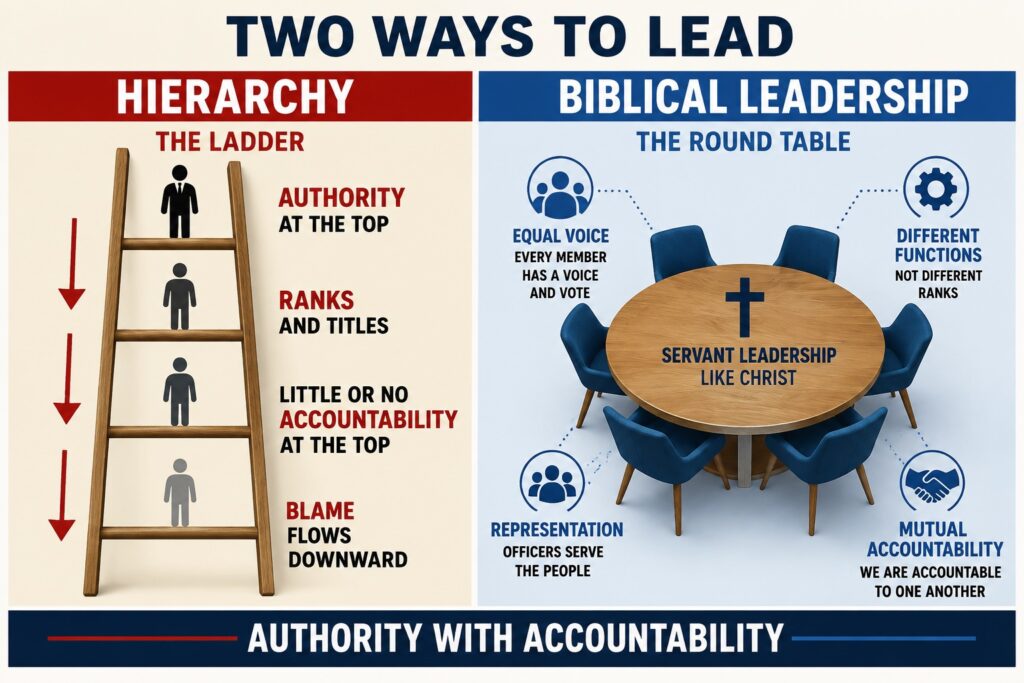
Hierarchism is an organizational structure based on ascending ranks, like a ladder. The military is hierarchical, with generals, colonels, sergeants, and so on down to privates. Authority is entirely vertical with little or no accountability at the top. Privates cannot hold a general accountable for his actions. Blame is always passed downward.
Hierarchy may appear efficient, but the dangers of hierarchy in Christian organizations become evident when authority rises upward while accountability disappears. Biblical leadership points in another direction: service, representation, and accountability.
Large corporations are also structured hierarchies, with CEOs, vice presidents, and department managers on down to those who stock shelves. Again, authority is always concentrated at the top, with no accountability there. Lower ranks usually take the blame for the errors of management. Officers within hierarchies do not represent the will of their subordinates.
Biblical government is fundamentally simple and the opposite of this hierarchical model. Officers serve the people in a representative system.[1] When it comes to the relationship of officers to one another, as in a presbytery,[2] every member has an equal voice and vote. There are no ranks, merely differences in function. If there is blame, it accrues to the group as a whole.
The ladder versus the round table
The difference between the two is like a ladder versus a round table. Since the goals and purposes are different, so are their structures.
When Christian organizations mimic the world’s system, they tend to thwart the central principles Christ taught. People become lost in a maze of bureaucracy as a monolithic machine feeds itself rather than the people. The organization focuses on perpetuating its own existence, as though that had intrinsic value.
Why hierarchy can be dangerous
During many years in ministry, I have had the opportunity to closely observe the dangers of hierarchy in Christian organizations.
By mirroring the world’s structures, Christians may unwittingly forget a central aspect of biblical theology, the corrupt nature of man. In a Christian organization the issue is not efficiency but sanctification.
Dictatorship is the most efficient form of government known to man. That is why dictators are difficult to defeat. They dehumanize people, depriving them of the free expression necessary to reflect God’s image. It is the straight line between two points, but casualties are strewn along its sides.
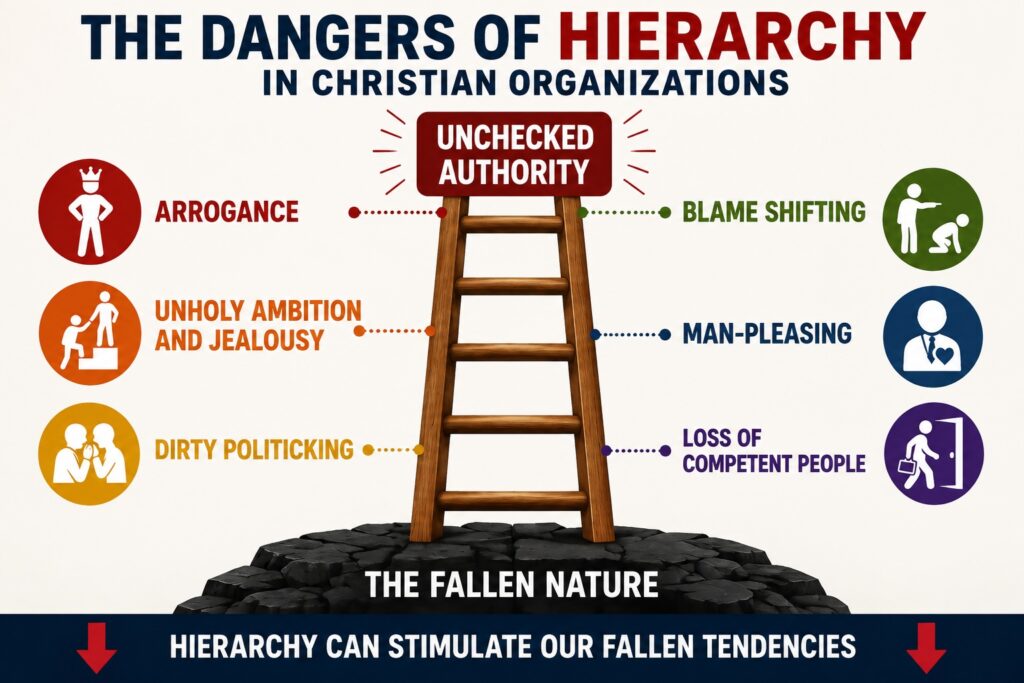
To discern the morality of a leadership structure, one should ask what it stimulates … the fallen nature, or the new nature in Christ.
THE PETER PRINCIPLE: Mediocrity and incompetence
In his classic book, The Peter Principle [3], sociologist John Peters describes how each member of a hierarchy tends to rise to his level of incompetence. As a person performs well at one level, he may be promoted to the next, until he attains a position beyond his abilities. He will remain at this position generating problems for himself and others. Meanwhile, many frustrated yet gifted people abandon ship. With time, incompetence multiplies until the organization as a whole becomes mediocre.
Good Christian leaders, functioning within a hierarchical system, try to mitigate these negative effects. Their efforts may be laudable but often end up futile. Human nature, including in Christians, is susceptible to the temptations generated by hierarchy.
How hierarchies stimulate the fallen nature
Arrogance
Hierarchies provide a platform where one person feels inherently superior to those of lower ranks. “I have a superior rank because I am a superior person.”
Unholy ambition and jealousy
A person sees another in a rank above his and says to himself, “He is no better than I.” In fact, I can do his job better. So why shouldn’t I have that rank?”
Dirty politicking
If a person wants a superior rank, he may be tempted to use his connections to get it. Such behavior is morally questionable and wastes time and energy for productive work.
The Apostle James notes,
For where you have envy and selfish ambition, there you find disorder and every evil practice. James 3:16
The term “evil practice” translates phaulon pragma, literally “foul business.”[4] “Dirty politicking” expresses it well.
Blame shifting
Human nature has a tendency to blame a subordinate when something goes wrong. Blame shifting was Adam’s first reaction after the fall. Such behavior is a form of moral cowardice.
Imagine a man carrying a load up a ladder. If he drops it, where does it fall? On whoever is beneath, who, in turn, dumps it on the one below him. The person on the very bottom gets the full load. In a hierarchy, the load is the blame.
Man-pleasing
Since a person’s rank in the hierarchy depends on the good will of the rank above him, this tempts him to focus on pleasing the person above him rather than God.
Loss of competent personnel
According to Dr. Peters in The Peter Principle, hierarchies tend to squeeze out people who question the way things are done, even if they are highly competent.
A hierarchy, like any organism, becomes more focused on perpetuating its existence than on what it was created to produce. People who rock the boat will be tossed out of it. It doesn’t matter if they were among the few doing the rowing,
Disregard of the ordained office and its spiritual authority
I mention this last for emphasis, not because it is least important. In fact, I consider it the most serious repercussion of authoritarian structures. In a Christian hierarchy, man-made titles or ranks sometimes negate the spiritual authority of biblical ones. The Word of God accords certain rights and privileges to all ordained officers. Hierarchical structures overlook these.
Leading within an authoritarian structure
With a little imagination, you can install administrative devices to limit the damage. Doing so requires a rare moral courage. Why? These strategies require accountability to the people you lead. [5]
Safety devices
Periodic evaluations of your leadership
Anonymous evaluations of your leadership in writing, from the people you lead. This provides subordinates the opportunity to say what they really think and to do it in safety. You will receive the truth about your leadership style.
Create an anonymity committee
This committee may consist of two or three people who can receive complaints without revealing the sources. If there are enough complaints about a particular leader, the issue can be brought to the attention of upper-level management before the leader is able to do serious damage. The reason the process requires moral courage is because the leader in question might be you.
Tip: Do not insult the intelligence of your subordinates by announcing an open door policy unless they can hold you accountable for what you say or do to them inside the door. [6]
Memos
Asking subordinates for feedback about proposed policies. This approach gives them a sense of participation in the decision process.
Any device that allows you to be vulnerable to your subordinates and accountable for your actions will gain respect and credibility. Ironically, once you have respect and credibility, those devices will likely become unnecessary.
Evaluating a Christian organization
A good way to discern if the organization is authoritarian is to ask, “In what way can you be made accountable for how you treat subordinates?” If you receive no answer, look elsewhere.
Summary
Authoritarian hierarchism is unbiblical for Christian organizations or churches. It stimulates latent tendencies in our fallen nature. These dangers of hierarchy in Christian organizations are therefore spiritual and moral, not merely administrative. Christian leaders should be aware of these tendencies and establish measures to minimize them. This may require an uncommon moral courage and commitment to absolute integrity and accountability to those we lead.
From this article we learn:
- Authoritarian hierarchism is a secular form of organizational structure, antithetical to the leadership principles Christ embodied.
- Authoritarian hierarchism stimulates the worst in human nature, leading to arrogance, selfish ambition, politicking, blame shifting, and more.
- Christian leaders involved in such structures can mitigate the damage by instituting administrative devices to make themselves approachable and accountable to those they lead.
Notes:
[1]. Since I am Presbyterian, I consider Presbyterian-style government to be the best reflection of biblical church government principles.
[2]. A Presbytery is a council of ministers and elders representing associated churches in a region or large city. It meets to deal with matters in common. The term is derived from the Greek term PRESBITERION, used in 1Tim.4:4.
[3]. This entertaining little book is a must for anyone trying to understand how hierarchies can become so incompetent.
[4]. Accordance Bible Software. Oaktree Company: Temecula, CA, 1999
[5]. Some organizations may insist they are accountable. What they often mean is they are accountable to the next person up the ladder, not to anyone below. This is not accountability in the sense we mean here.
[6]. An open door policy means telling your subordinates they are welcome to come into your office and discuss their concerns. Most people have enough sense to ignore this offer.
###
Free books, essays and study guides
Recommended Readings:
How to Deal With an Incompetent Leader
Reformed Church Government: A study guide
Christian Leadership: Suffering, Parity, and Service
If you liked this article, you may enjoy our book,